
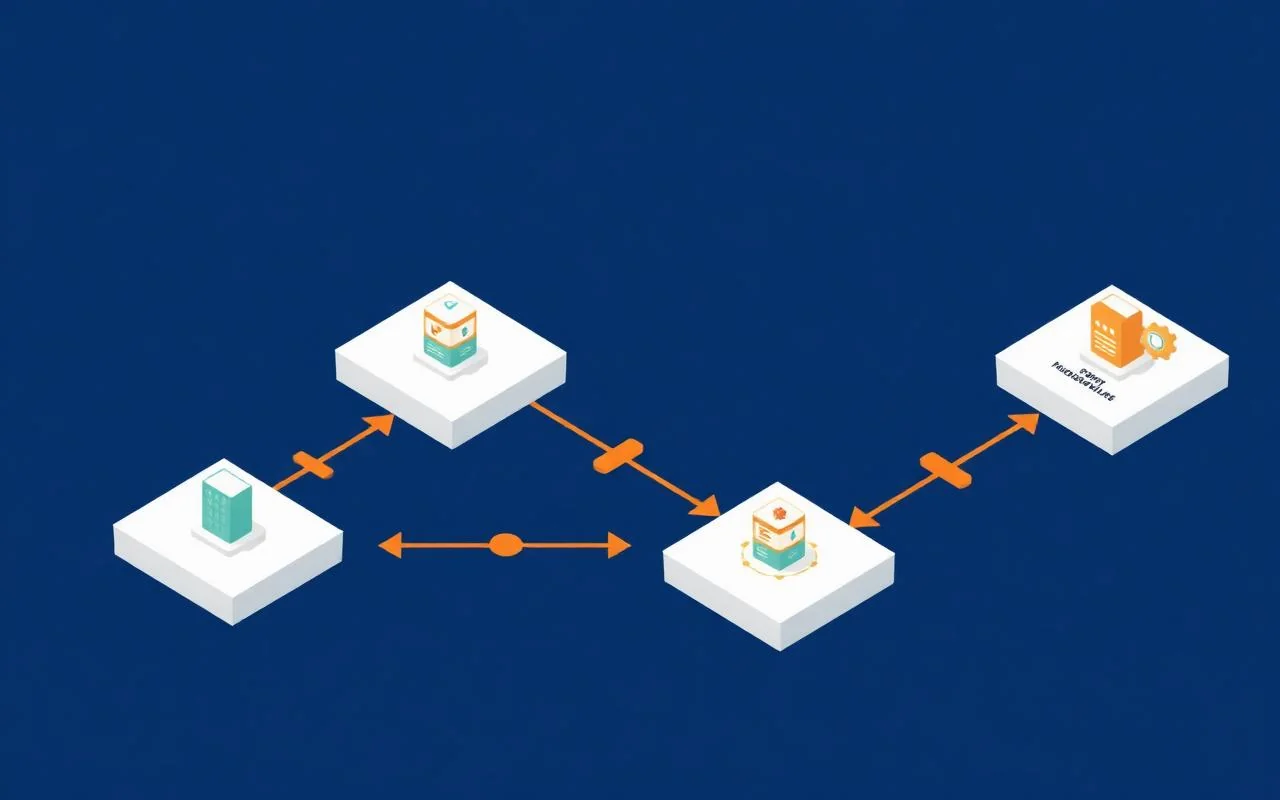
What is IT Service Management (ITSM)?
IT Service Management (ITSM) is the discipline of designing, delivering, managing, and improving the way IT is used inside an organisation. Instead of treating IT as a stack of tools, ITSM treats it as a portfolio of services — email, connectivity, ERP access, endpoint support, cloud workloads — each with defined owners, SLAs, and continuous improvement loops.
For enterprises in India and globally, ITSM is what separates a reactive help-desk from a predictable, measurable operations function that leadership can plan around.
Why ITSM matters for enterprise efficiency
Without ITSM, IT teams firefight. Tickets pile up, changes break production, and no one can answer "how reliable is our IT, really?"
A mature ITSM practice delivers four measurable outcomes:
- Higher uptime — incidents are detected, categorised, and resolved against SLA.
- Lower change-failure rate — every production change is reviewed, tested, and reversible.
- Faster onboarding — standard service requests (laptop, VPN, SaaS access) are catalogued and automated.
- Auditable compliance — every action is logged, mapped to ISO 27001, SOC 2, or DPDP controls.
The ITIL framework in one page
ITIL (Information Technology Infrastructure Library) is the world's most widely adopted ITSM framework. ITIL 4 organises IT work into a Service Value System with these building blocks:
- Service Value Chain — plan, improve, engage, design & transition, obtain/build, deliver & support.
- Guiding Principles — focus on value, start where you are, progress iteratively with feedback, collaborate, keep it simple, optimise and automate.
- Practices — 34 documented practices (incident management, change enablement, problem management, service request management, monitoring & event management, service desk, etc.).
You do not need to adopt all 34 practices on day one. Most Prime Fixel engagements start with four.
The four core ITSM processes every business should run
1. Incident Management
Restore normal service as fast as possible when something breaks. Priorities are set by impact × urgency, and every incident carries an owner, a resolution SLA, and a post-mortem trigger if it breaches P1/P2 thresholds.
2. Problem Management
Find the root cause behind repeat incidents. A single laptop crash is an incident; the same driver crashing 40 laptops is a problem. Problem management prevents the next incident instead of just closing this one.
3. Change Enablement (Change Management)
Any modification to production — a firewall rule, a DNS record, a Kubernetes deployment — flows through a change request with risk, rollback, and approval. Standard, low-risk changes are pre-approved; normal and emergency changes go through a CAB (Change Advisory Board).
4. Service Request Management
Everyday user asks — new laptop, mailbox restore, VPN access — handled through a catalogue with defined SLAs and, wherever possible, automation. This is where end-user satisfaction is won or lost.
How managed IT providers use ITSM to guarantee uptime
At Prime Fixel, ITSM is not a document — it is how our NOC actually runs:
- Monitoring & event management feeds our incident queue automatically, so we see problems before your users do.
- Runbooks attached to each service turn a P1 outage into a rehearsed response, not an improvised one.
- Change windows and CAB reviews stop the most common source of downtime: a well-intentioned change made at the wrong time.
- Monthly service reviews report SLA attainment, incident trends, and improvement backlog to your leadership.
The result is what our SLA promises: measurable uptime, transparent reporting, and no surprises.
ITSM vs ITIL vs DevOps — clearing the confusion
- ITSM is the what — managing IT as services.
- ITIL is the how — a best-practice framework for doing ITSM.
- DevOps is a culture focused on developer/operations collaboration and fast, safe delivery.
Modern operations blend all three: ITIL 4 explicitly integrates DevOps, Agile, and Lean.
Getting started with ITSM
- Pick one service to formalise first (usually the service desk).
- Stand up an incident + service-request queue with clear SLAs.
- Introduce a lightweight change process for production.
- Add problem management once you have 30–60 days of incident data.
- Review, measure, iterate.
Need help operationalising ITSM for your business? Prime Fixel's Managed IT team runs ITIL-aligned service operations for enterprises across India — reach out via our Contact page or explore our Managed IT service.
Frequently asked questions
Is ITSM only for large enterprises? No. Even a 30-person company benefits from a ticketed service desk, a change log, and a service catalogue. ITSM scales down as cleanly as it scales up.
Do I need certified ITIL people to adopt ITSM? Certification helps, but adoption matters more. Start with the four core processes above and hire or partner for depth as you grow.
How is ITSM different from a help-desk tool? A help-desk tool is software. ITSM is the operating model that decides how the tool is used, what SLAs apply, and how work improves over time.